Friday, 28 November 2025

Andaman Adventures

With summer around the corner, the traveller in me stirred, restless for a new adventure. But, with four of us in the family—each with different interests—choosing a destination was no easy task. My better half enjoys laid-back vacations, while the kids crave adventure, and I take the middle path. After much deliberation, we found the perfect compromise: the Andamans. To bring our dream trip to life, we entrusted Sensational Odyssey, which carefully curated our itinerary to strike the ideal balance between relaxation and adventure.

Day 1 - Port Blair  & Veer Savarkar Jail

Thus, our journey began. Opting for comfort over an early start, we took a midday flight from Bangalore to Port Blair. The airport, named after Veer Savarkar, a freedom fighter who made immense sacrifices for India’s independence, was a fitting first impression of the Andamans. The moment I saw his statue outside, I instinctively saluted him in my mind.


Veer Savarkar Statue

As we stepped out of the small, shell-shaped defence airport,
a warm sea breeze greeted us. Our travel partner’s agent was already waiting,  ready to escort us to the iconic Cellular Jail, a national monument. 

Shell-shaped airport, Port Blair

After a hearty lunch, we set out to explore the infamous prison, also known as Kala Paani. It is indeed a place of pilgrimage for all the patriots. The place was bustling with visitors, yet a solemn air lingered in its corridors. From history lessons, I had always known Andaman as a land of punishment, a place where freedom fighters were exiled and subjected to unspeakable hardships. Standing here, that history felt more real than ever.

Cellular Jail (Kaala Pani)

Near the entrance, a small museum displayed haunting photographs and accounts of the prisoners' intolerable experiences. Each exhibit told a story of resilience and sacrifice, making us pause and reflect on the price of freedom.


As we stepped into the premises of the Cellular Jail, we were greeted by a sprawling banyan tree—its roots grounded in silence, its branches seemingly reaching out to the past. It has stood as a mute witness to the most brutal and barbaric atrocities meted out to our freedom fighters. It set the tone for what was to come.

Banyan Tree in the Jail Complex
                    

  Our tour began at the gallows,  a chilling reminder of the brutal punishments meted out to those who dared to dream of a free India. The sight of the noose and the wooden platform beneath it sent a shiver down my spine. A heavy silence hung in the air.

Jail Corridor

We then moved toward the prison cells. Identical, cold, and desolate, each one wore a look of quiet despair. It felt as though the very bricks were murmuring stories of pain, isolation, and unbroken resolve. These were not just cells—they were silent storytellers of a dark but defining era.


The cell that drew us the most was that of Veer Savarkar. At the entrance, a board detailed his imprisonment and contribution to India’s freedom struggle. Inside, we found two poignant photographs—one from his days in confinement and another, an older portrait. A simple bedsheet, bowl, and plate—his belongings from that time—lay preserved, quietly reminding us of the harsh realities of prison life. I stood still for a moment, saluted him, and walked out, carrying a deep sense of respect.


Inside Veer Savarkar's cell

Post the cell tour, we visited the in-house museum. It featured life-size representations of prisoners, shackled with different types of handcuffs and leg irons. We saw displays of punishment attire and the kinds of forced labour assigned to inmates. Each exhibit brought us face-to-face with the cruelty and endurance of those imprisoned here.


A gunny bag dress, which is supposed to increase body heat and cause discomfort

As dusk fell and the clock struck 6, the 'light and sound' show began. It was a breathtaking tribute to India’s freedom struggle—narrating the sacrifices and dreams of countless heroes through music, narration, and dramatic visuals. As the show ended, I found my eyes moist, my heart full—swelling with pride, pain, and patriotism.

This visit wasn’t just a tour—it was a powerful reminder of the cost of our freedom, and the resilience of those who fought for it. If you ever find yourself in the Andamans, a visit to the Cellular Jail is not just recommended—it’s essential.

Day 2 - Havelock Island

We woke up fresh and recharged, ready for our next adventure—Havelock Island, now officially known as Swaraj Dweep. There was a buzz of excitement as we headed to the jetty, where our cruise awaited. Like clockwork, all tourists were dropped off much in advance and made to wait until the cruise arrived. The anticipation only added to the thrill.

Finally, after what felt like an eternity, the cruise made its appearance. The journey itself was a treat—an hour and a half of gliding across the sea, watching waves dance alongside us. It was the kind of ride that makes you forget time. 

Cruise ride to Havelock Island

Does this ring a bell? Yes, the same lighthouse that is printed on our 20-rupee note. 

As the shores of Havelock slowly came into view, our excitement peaked. We were welcomed by our travel partners and escorted to our hotel for a quick rest before setting out again.

Jetty @Havelock

Our destination was one of the most spectacular beaches in the Andaman Islands—Radhanagar Beach. Often hailed as the crown jewel of Havelock, Radhanagar Beach was ranked the best beach in Asia and the 7th best in the world by Time Magazine in 2004. With its expansive coastline hugged by lush tropical forests, it felt like stepping into a dream.

As we walked along the soft white sands, we passed several photo shoots in progress—especially of newlyweds capturing their perfect moments. Cupid indeed was at work. 

 While walking, something artistic on the sand caught my eye. Tiny sand balls arranged in intricate spiral patterns were scattered across the beach. 

Artwork by crabs on the Radhanagar beach 

 I paused and watched closely—these were created by small sand-bubbler crabs. Emerging from their burrows, they sift the sand through their mouthparts to extract microscopic food particles, leaving behind neat little balls of cleaned sand. It was mesmerising to watch them at work—a true marvel of nature.

 Soon, we were in the water, letting the waves wash over us as we laughed and played like children. The ocean was alive, crashing into us with joyful energy, and we matched its spirit with our own.


As the day drew to a close, the sky transformed into a masterpiece. The sun turned into a glowing orange orb, slowly dipping into the sea. The sky erupted into a riot of colours—blue, grey, gold, lavender, and soft pink. It was a sunset I’ll never forget.

Sunset @ Radhanagar beach

The waves calmed, and the day came to an end. But the memories? They lingered and left footprints in our hearts. 

Day 3 

Taking the Plunge: My First Scuba Diving Experience in Havelock

This day was the most exciting of our entire trip as I was going to scuba dive for the very first time, along with the boys! While they were bubbling with excitement, I must admit—I was a bit nervous. But my willpower overpowered the nervousness. We put on our diving gear and walked towards the sea. The dive instructor greeted us, patiently explaining the rules and guiding us through a 15-20 minute training session. Before I knew it, we were boarding a boat, heading out to deeper waters for the real deal.

As I strapped the oxygen cylinder onto my back and fitted the mask onto my face, my heart began to pound. I watched as the boys jumped in first, one by one, disappearing into the blue below. And then—it was my turn. I took a deep breath and plunged into the water, summoning every bit of courage I had. What followed in the next half hour was nothing short of magical.

Scuba diving @ Havelock

Beneath the surface, an entirely different world opened up. Vibrant coral reefs stretched out like underwater gardens, and schools of colourful fish danced around us in perfect harmony. Sea creatures glided gracefully at different depths, going about their lives in peaceful rhythm. It was silent, surreal, and incredibly humbling.

Fascinating Nemo fish 

In that tranquil, otherworldly space, a deep sense of gratitude filled my heart—for the beauty I was witnessing, for the courage I found within myself, and for the chance to experience this breathtaking underwater universe.

No words can truly capture what I saw or felt beneath the waves. But that thirty-minute underwater experience will be etched in my memory forever.

We had two more beach visits planned for the same day, Kalapathar and Elephanta beach. Post breakfast, we set out towards Kalapathar Beach, one of the many scenic gems of Havelock Island.

Kalapathar Beach

This beach offered a picturesque stretch of white sand, beautifully contrasted by large black rocks that lined the shore. The turquoise-blue water was mesmerizing, a visual treat that calmed the senses. 

Kalapathar Beach

Though the beach itself was relatively small, it exuded a quiet charm and serenity that made us want to stay longer. It was the kind of place where time stands still, perfect for a peaceful, unhurried stroll or simply soaking in the natural beauty.

We captured some lovely moments here—both in our cameras and in our hearts. As much as my mind lingered, wanting to stay and savour the place a little longer, we had to move on. Our next destination, Elephanta Beach, awaited us, and it was still a bit of a drive away.

Elephanta Beach

Elephanta Beach is one of the major attractions of Havelock Island, known for its vibrant marine life and thrilling water sports. To reach the beach, we boarded a ferry that took about twenty minutes, offering scenic views along the way.


As we arrived, we were greeted by clean, inviting shores and shallow waters teeming with bright coral reefs. The place buzzed with energy—there were plenty of water sports to choose from, including kayaking, banana boat rides, parasailing, and more. We couldn’t resist the excitement and tried a couple of them, adding a dose of adventure to our day.

While exploring the shore, the boys stumbled upon some fascinating marine creatures.

Those beady eyes of the crab!

 Unlike other beaches where we mostly find empty shells, Elephanta Beach revealed a thriving and diverse ecosystem—it was a delightful surprise.


After soaking in the experiences and marvelling at the beach’s natural beauty, we decided to call it a day and head back to our hotel rooms to relax and reboot. 

Day 4 - Neil Island (ShaheedDweep)

Neil was the final island on our itinerary. After breakfast, we found ourselves once again repeating the now-familiar routine—heading to the jetty, enduring a long wait, and boarding the cruise. This time, however, the excitement of ferry travel had slightly faded. The novelty had worn off, and the hour-long journey felt a bit more tiresome than before. But all fatigue melted away as we set foot on Neil Island. We were promptly escorted to our hotel, where we rested briefly before setting out to explore.

Bharatpur Beach

Our first stop on the island was Bharatpur Beach, located just a kilometre from the jetty. It was a pretty white sand beach with calm, shallow water and soft waves gently kissing the shore. The beach had a cheerful, family-friendly atmosphere, with groups wading in the crystal-clear water and children splashing about safely in the shallows.

Bharatpur Beach


What made the beach even more inviting were the trees along the shore, many of them adorned with hammocks that swayed gently in the breeze. These cosy spots, coupled with the picturesque view, made the beach feel almost idyllic. For those preferring to stay on the sand, plastic sheets were available for rent, and people could be seen lounging comfortably under the trees.


The beachside was lively, with several restaurants and souvenir shops adding a splash of color and activity to the scene. We spent a good amount of time simply relaxing, soaking in the calm and carefree vibes of the place. After a leisurely lunch at one of the nearby restaurants, we headed back to our rooms for some rest, allowing ourselves to unwind after another beautiful day by the sea.

Laxmanpur Beach

Laxmanpur Beach is renowned for its breathtaking sunsets, and we were fortunate that it lay just next to our hotel, with direct access from within the premises. This made it perfect for a leisurely evening stroll. The beach was scattered with dead corals, carried ashore by the waves, adding a rugged texture to the serene landscape. We settled into the seats thoughtfully placed by the hotel, ready to bid farewell to the day.

Watching sunset @ Laxmanpur Beach

As the sun began its descent, the sky was set ablaze with fiery hues, casting a magical glow over the sea.


The corals, silhouetted like boulders in the foreground, reflected softly in the water, creating a dramatic and almost surreal scene.  

Riot of colours      
  
                                                    
The blue hour silhouette

After basking in the soothing hues of dusk, we returned to the hotel for a sumptuous dinner, content and grateful for a day filled with nature and quiet reflection. 

Day 5: A Morning in Neil: Sitapur and the Natural Bridge

This was the day we were set to return to Port Blair, but before that, I was eager to visit Sitapur Beach to catch the sunrise, followed by a stop at the famous Natural Bridge.

We woke up in the early hours, hoping to witness a stunning sunrise at Sitapur. Unfortunately, our efforts were in vain—the sky was overcast, and the sunrise was hidden behind thick clouds, leaving us disappointed.

Sunrise @ Sitapur was marred by dark clouds


Without wasting much time, we headed straight to the Natural Bridge. As the name suggests, it’s a naturally formed coral bridge. Nature had beautifully decorated it with hanging creepers, giving it a unique charm.

Natural Bridge

Since the tide had gone out early that morning, the sea had pulled back, exposing coral beds and leaving behind numerous small ponds. We had to carefully navigate through them. But these weren’t just puddles—they were full of life. Each one felt like a tiny aquarium, brimming with colourful fish and living corals. The richness of this mini-ecosystem was fascinating and quickly made up for the missed sunrise.


Mini aquarium just beneath the water surface


With the clock ticking, we wrapped up the visit and made our way to the jetty, ready to head back to Port Blair.

Ross Island – The Abandoned Beauty & Chidia Tapu – A Quiet Goodbye

After landing back in Port Blair, we made our way directly to Ross Island via a short ferry ride of about 10–15 minutes. Now officially known as Netaji Subhash Chandra Bose Island, this abandoned island holds echoes of a bygone era. Once a grand British settlement, the island now lies in ruins, its roofless structures entwined with massive roots and vines, giving it an eerie, almost mythical charm. Amidst the silence, we spotted several deer wandering freely through the ruins, adding to the island’s surreal atmosphere.


From there, we continued to Chidia Tapu, where we were to spend the rest of the day. Known for both its birdlife and sunsets, we hoped to catch at least one of the two. But once again, thick clouds veiled the sky, hiding both the birds and the sunset from view.

The next morning, I took a quiet walk to Chidia Tapu Beach, just a short distance from our stay. The sea was unbelievably calm, more like a serene lake than the open ocean. Several boats were anchored along the shore, creating a postcard-perfect scene that felt like nature’s gentle farewell.

Chidia Tapu Beach

And with that, our wonderful journey came to a close. After a hearty breakfast, we packed our bags and prepared to return home—hearts full and minds refreshed.

This was truly one of the most adventurous trips I’ve had, and I’m already looking forward to my next scuba diving experience!


Tuesday, 26 September 2023

Embarking on a Spiritual Trek: Chardham Yatra (25th April - 06th May 2023)

                                                                                                                                          Source: Internet

Kedarnath - the mere mention of this word brings before my eyes, the TV footage that showed buildings collapsing like a pack of cards, a huge pileup of dead bodies right in front of the temple, entire villages and towns being swept away in the devastating Himalayan tsunami in 2013. However, the temple and the people inside were miraculously saved - a testament to the resilience and power of faith. Probably, that was the day when I quietly sowed the seed of visiting this place, which till then was unknown to me. 
Exactly 10 years later, I manifested this wish when our family and a few others booked our customised Char Dham Yatra with GoTravelTales. 

On April 25th, we set forth on our 12-day journey. When I realised that our journey coincided with  'Shankara Jayanti', the birth anniversary of the great philosopher and saint Adi Shankaracharya, I was double assured that we had his blessings for our spiritual expedition. 

Chardham Yatra consists of four sacred sites, Yamunotri, Gangotri, Kedarnath and Badrinath (listed in the clockwise order in which they are usually visited) - all located in the Uttarakhand state (aka DevBhoomi) and situated in the higher reaches of the Himalayas. 
Gone are the days when this yatra was undertaken during the last leg of one's life term owing to its great challenges in terms of rugged Himalayan terrain and harsh climate. Now, people across age barriers are embracing it, thanks to infrastructure, technology and awareness. The difficulties faced during the journey hold a spiritual significance as they test one's devotion and dedication to the divine. 

 On day one, we flew from Bangalore to Dehradun and drove to Rishikesh, the abode of sages. Known as the 'Yoga Capital of the World', it is a melting pot of spiritual seekers, tourists and adventure enthusiasts. 


Rishikesh
 
River Ganga in Rishikesh
Brightly lit Ram Jhoola 

We headed towards Parmarth Niketan Ashram and Gita mandir, crossing Ram Jhoola and making our way through the crowd.  Ram Jhoola is an iconic suspension bridge over the Ganges, offering panoramic views of the river.  Ganga Aarti is held on the ghats of the ashram in the evenings.  


The next day, left for Yamunotri via Mussoorie, Barkot and visited Kempty Fall en route. 

Yamunotri

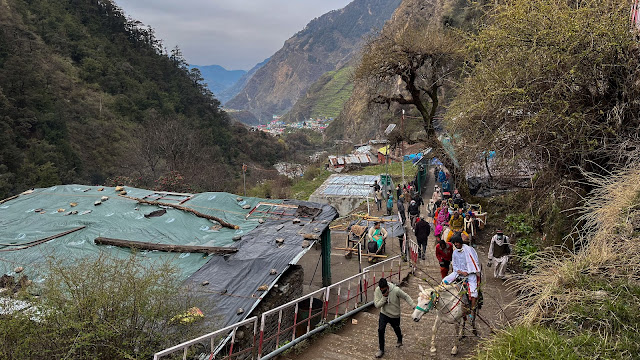
Drove to Jankichatti early in the morning to start the 6km trek to Yamunotri. As this was our first destination, all our batteries were fully charged as we started trekking. It was a steep ascent to the top.


Mules hydrating themselves before the trek


A palki

Eateries on the way
A yatri being carried by a pittu
Pilgrims on their way to Yamunotri

We enjoyed the natural beauty around us and also the snow-clad Himalayan peaks as we hiked.  

Yamunotri peaks


                             Yamunotri temple          Source: Internet


By the time we reached the temple, it was overcrowded.  We managed to catch hold of a panda (pilgrimage priest) who waded us through the sea of people to take us inside the temple and get the pooja done. 


There is a natural hot spring, Surya Kund in the temple premises where people take a dip for spiritual cleansing. We were surprised to see that rice which was dipped in this spring would get cooked instantaneously and was being offered as prasad to devotees. We had to leave immediately after the pooja as the weather was getting bad. The entire descent was quite damp which dampened our spirits as well. 

Didsari Hanging Bridge over Bhagirathi river

Bird's eye view of Uttarakhand's beauty


On the fourth day, we drove to Uttarkashi (a.k.a Soumya Varanasi) and visited Vishwanath temple. This temple is one of the oldest Shiva temples in Northern India, constructed in 1857 and is one of the twelve jyotirlingas.

Uttarkashi

Vishwanath temple, Uttarkashi


Right in front of this temple is Shakti temple which has a huge Trishul(6 mts in height and 90 cm in diameter)  erected inside.  This was supposed to have been thrown on the devils by the Goddess Durga. 

Shakti Temple, Uttarkashi

Harshill

Harshil is a picturesque village in the Himalayas's lap, situated on river Bhagirathi's banks. Known as the 'Mini Switzerland of India', it has stunning natural beauty, and a serene environment and offers panoramic views of the surrounding Himalayan peaks.  This place also had a lot of apple orchards which were white-washed with apple blossoms.  

Apple trees


Apple blossoms


Harshill, a village in Uttarkashi


The next day early morning left towards Gangotri. 

Gangotri


En route Gangotri


The journey was enchanting as we witnessed a couple of scenic spots where Bhagirathi was gracefully winding its way through the landscape. It was a sight to behold. 

The waters of Bhagirathi are a captivating shade of turquoise blue. All along its course, the river is embraced by the elegant presence of deodar trees on both sides, creating a harmonious blend of colours that soothes our senses. This is further enhanced by a breathtaking backdrop of snow-peaked Himalayan mountain ranges. 
It was truly an unparalleled charm of nature's masterpiece which left a long-lasting impression on me and I felt fortunate to witness it. 

A mesmerising view of river Bhagirathi flowing gracefully through the mountains


Gangotri is easily accessible, unlike Yamunotri. You will find yourself amidst towering Himalayan peaks reaching the sky. Deodar trees and alpine shrubs dot the landscape providing refreshing visual contrast to the rocky terrain. 

Rocky terrains of Gangotri

Gangotri peaks

The pathway to the temple is dotted with numerous shops selling pooja items as well as eating joints.  As you reach the temple premises, you will see the Bhagirathi River with its pristine turquoise-blue water flowing nearby and adding a touch of serenity to the scene.  The sound of the flowing water complements the tranquil atmosphere and creates a soothing melody that resonates with the spiritual atmosphere all around.  

Gangotri landscape

Gangotri temple


Proceeding directly to the riverbank, immersed ourselves in the icy waters of the sacred river for a refreshing dip. A sense of calm engulfed me after the bath. Following the dip, we presented our offerings and conducted an aarti ceremony to honour Mother Ganga. Subsequently, we entered the temple premises which was by then quite crowded due to the influx of visitors.

On our return journey, we cherished hot Jilebis which perfectly complemented the chilly weather.

Hot n sweet Jilebis

On the subsequent day, we drove to Guptkashi for an overnight stay and then proceeded towards Sonprayag to embark on the Kedarnath trek at 4 in the morning.

Rudraprayag, confluence of Alakananda from Badari(left) and Mandakini from Kedar(right) 


Views near Tehri Dam, the tallest dam in India and the 12th-tallest in the world


Kedarnath

Of the four dhams, Kedarnath was the destination we had eagerly anticipated. However, our plans took an unexpected turn as the rain began to fall, leading to the suspension of vehicle movement well before reaching Sonprayag. Faced with limited options, we initiated our journey on foot.

Upon reaching Sonprayag, we were met with a lengthy queue. Before we could even reach the registration counter, the clock struck 11:30, and we learnt that the day's trek at Kedarnath had been called off due to deteriorating weather conditions uphill. However, we were determined not to return without experiencing the divinity of the place. Hence, we secured a room close to the counter, and our plan was to either make every possible effort to continue our journey on the same day or, in the worst-case scenario, set off early the following morning. Our perseverance paid off when a compassionate policeman, who had been observing us, took pity and granted us permission to move ahead towards Gaurikund. Kedarnatheshwara had blessed us in disguise. Gaurikund serves as the initial point of the trek leading to Kedarnath, and it is where Goddess Gauri underwent penance to earn the favour of Lord Shiva.

This was just the initial hurdle. By the time we commenced our ascent, the clock had already struck 3 p.m., a rather late hour to start the trek on the rugged terrain. Horsemen were returning from the summit and were unprepared for another journey so late in the day. It typically takes anywhere between 6 to 10 hours to reach the top on foot, and given the age range of our group, this seemed like an impossible task. However, through the grace of God, we managed to secure mules for all of us, albeit at very high prices and began our trek.

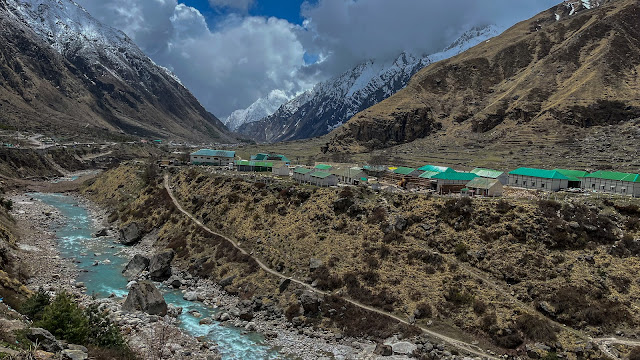
Views en route Kedarnath

The difficult terrain and vagaries of the weather are never a deterrent to the people who visit this place. All kinds of people, both old and young, some of them even carrying small children in their arms, and a few others lacking adequate warm clothing or suitable footwear were seen climbing up and down throughout our voyage.

Trekking path to Kedarnath

The mule ride proved to be quite frightening, as its owner would neglect to grasp the nose thread quite a few times, causing the mule to attempt to bolt, resulting in my terrified screams. However, options were limited, so I resolved to remain atop the mule, reciting the panchakshari mantra. It was a mindful prayer for the next 5-6 hours. How I wish I could be in that state all the time! Some travellers journeying along the trail were engaged in fervent prayers to the Lord. We were in divine alignment with all others who were ascending with us.

Snow-clad peaks of Kedarnath

Lady Luck smiled at us as the weather took a turn for the better and became quite pleasant. The environment around me was truly breathtaking, although my unease from riding the mule and the constant fear of slipping detracted from my ability to fully appreciate it. As we approached our destination, the sky was pristine blue and the full moon radiantly illuminated the snow-clad blue-hued mountain peaks. This sight evoked in me an image of Lord Shiva adorned with the moon nestled in his hair.

Moonshine in Kedarnath

We dismounted the mule and began walking, hoping to refresh our eyes with the enchanting view of the sacred temple. This stretch of the journey was immersed in darkness, stars were twinkling above and lit up the ink-dark sky. The path beneath us was a slushy mix of snow. Despite these challenges, we continued on foot, yet the temple remained elusive in the distance. Eventually, after a considerable walk, we caught sight of the temple, and the realization dawned upon us that we had covered a distance of nearly 2.5 kms. The sight of the temple sent chills down my spine, a mix of awe and reverence.

My first glimpse of the temple


Given that it was nearly 11 p.m., the temple doors were closed, prompting us to make our way directly to our hotel rooms which were hardly 50 meters from the temple. It was then that we recognized our hunger, having gone without a meal since breakfast. Fortunately, luck was on our side as we managed to find a place to serve dinner at that late hour. With the bitter cold seeping into the bed and thick blankets, we settled down to rest, seeking some reprieve from the frosty weather and hoping to catch a few hours of sleep.

The next day, got up in the wee hours and reached the temple by 4.30 am. The temple was still closed people had already lined up for darshan. Chantings of the Mahanyasa mantra were reverberating in the air. Mountains, wholly covered with snow, were forming a picture-perfect backdrop to Kedarnatheshwara.

Early morning scene at Kedarnath


The Kedarnath temple holds the distinction of being among the twelve jyotirlingas. While tradition attributes its initial establishment to the Pandava brothers, Jagadguru Adi Shankaracharya is believed to have played a significant role in re-establishing the temple. A strong aura surrounds this place where he chose to set up one of the four seats for his mathas. It is no wonder that a divine spell embraces everyone who visits this sacred location.


Linga here is a naturally formed and irregularly shaped rock, symbolising the abstract form of Lord Shiva and representing his divine energy and presence. To our delight, we were granted access to the inner sanctum where we had the privilege to touch the linga and perform abhisheka. While worshipping the linga, I experienced a profound state of bliss. As the place was still relatively empty, we decided to go inside again for a second darshan before visiting the samadhi of Jagadguru Sri Adi Shankaracharya.


A Naga Saadhu in the temple complex

Just behind the temple structure, you can see a huge rock, known as Bhim Shila which is supposed to have blocked the flood waters and protected the temple during the 2013 flash floods.


Bhim Shila - the one that protected the temple from 2013 floods

Beyond this is the samadhi of Adi Shankaracharya in black stone. The 12 ft. tall statue in the sitting position exudes a magical aura and radiance.

Samaadhi of Adiguru Sri Shankaracharya


Our descent began at around 9 a.m. and by then the place was bustling with people resulting in a long queue for the darshan. The helipad service which remained elusive to us had become operational that day and we could see a few of them moving around.


We deployed some pittus to carry all our luggage and freed our hands. Within a span of one to two hours, after we began our descent, the weather took a turn for the worse. It began raining, and this continued until we finished our descent at around 6 in the evening. We were drenched in His blessings.

With great difficulty, we managed to reach our vehicle parked in Sonprayag and reached Chopta in the middle of the night.

Chopta

Chopta is known for its serene natural beauty and the resort we stayed at is perched in the middle of an alpine meadow with a small stream flowing nearby.

Chopta Resort

Chopta, mini Switzerland of India

The resort provided us with excellent luxury and service. On the subsequent day, we took some time to relish the natural surroundings before embarking on our journey to Badrinath, our final destination.

Badrinath

Badrinath
Badrinath is located in the Chamoli district of Uttarakhand. It is situated in a picturesque setting surrounded by snow-capped peaks and, a lush green valley. River Alakananda flows through it and makes the landscape more beautiful. Badrinath temple is dedicated to lord Vishnu in his form as Badari Narayan. It stands against the backdrop of Neelkanth Peak. Taptkund, a natural hot spring is located close to the temple. In contrast to Kedarnath, this location offers relatively convenient accessibility, which exposes it to the challenges commonly encountered by heavily frequented tourist destinations.

Snow-clad peaks in Badrinath


Just like at our previous destinations, we made our way to the temple very early in the morning, hoping to have a peaceful darshan of the deity. The temple was adorned with exquisite decorations, and its grandeur could be seen from afar.


As we entered the temple premises barefoot, we immediately felt the biting cold. The temple was bustling with devoted pilgrims, and the sanctum was already crowded. Joining a lengthy queue we could only catch a distant glimpse of the Lord during our darshan.


The grandeur of Badrinath Temple

Large crowd of devotees


After having our breakfast, we left the place to go to the nearby Mana village.

Mana village, known as the 'last village of India', is situated very close to the Tibet border. It is famous for its distinctive culture and traditions, as well as its proximity to significant sites such as Vyas Gufha and Ganesh Gufha (believed to be the locations where the Mahabharata was composed) and the source of the Saraswati River.

Mana, the last village of India close to Tibet Border


Gallis of Mana

A wall art


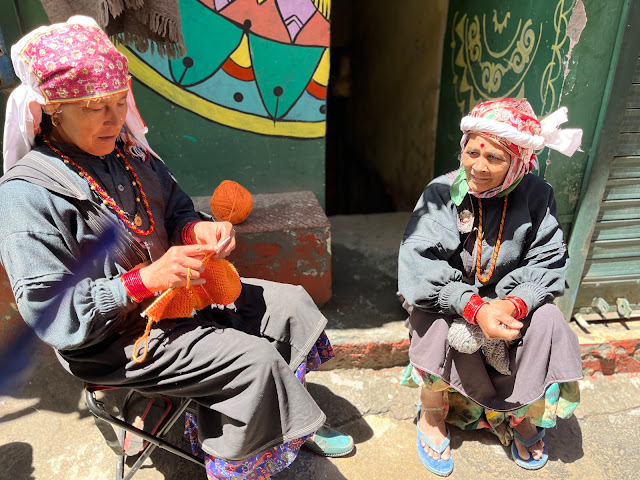
Artisans in the Mana village


But as the walk was quite long, we cut short our visit halfway through. This, proved to be a blessing in disguise as there was a heavy landslide en route just after we passed and people were stranded overnight on the road.

Devprayag, confluence of Alaknanda(left) and Bhagirathi (right)
Another view of Devprayag
On the way to Rudraprayag, we visited Dhari Devi temple at Kalyasaur on the banks of Alakananda River.  It is dedicated to Goddess Dhari Devi who is considered as a manifestation of Goddess Kali. She is revered as a guardian deity who protects those who live there and the Char Dham Yatra Pilgrims. It is believed that relocating or disturbing the Devi's idol can bring about natural disasters. In 2013, it was forcibly relocated as part of a hydropower project. Within hours, there were devastating floods in Kedarnath proving the temple's protective powers.  

Dhaari Devi Temple
After resting at Rudraprayag, we reached Rishikesh in the evening to witness Ganga Arti in Triveni Ghat.

Ganga Aarti @ Triveni Ghat


We savoured hot jalebis that were sold in a shop near the ghat.

Haridwar

On the last day, visited Har Ki Pauri (Feet of Lord Vishnu) ghat which stands as a symbol of devotion, spirituality, and the rich cultural heritage of Haridwar. People across India come to this place to get a dip in the holy river Ganga.

River Ganga flowing in Haridwar


Har ki Pauri (Feet of Lord Vishnu) Ghat 


This place was blazing hot. After encountering subzero temperatures at all the Dhams, we were now experiencing temperatures around 37 degree Celsius. Our area exploration was limited as it was a quick visit en route to the airport. Later had our lunch and proceeded to the airport.

As we departed, we couldn't help but acknowledge the abundant blessings of the Lord that had graced our journey throughout. We were fortunate not to encounter any delays or the typical adverse weather challenges often experienced during this pilgrimage.

"Travel not only to discover new places but to uncover the depths of your soul. In the sacred journey, you may find that the destination is not just a physical location, but a profound connection with the universe within and around you." - Unknown

As we concluded our Yatra, it became abundantly clear that this journey was far more than a mere trip; it was a profound soul-searching adventure that intimately connected us to the divine beauty of nature. It indeed was a once-in-a-lifetime experience. While our bodies had been weary, our spirits soared high, and our hearts overflowed with gratitude.

This Yatra has not just been a journey; it's been a revelation, a reminder that the truest treasures are the ones we carry in our hearts.

If you have reached here, I thank you for joining me on this virtual pilgrimage. Your feedback is most welcome and encourage you to share this with others who may find it informative and inspirational to undertake the Yatra.